This site uses cookies to provide and improve your shopping experience.
If you want to benefit from this improved service, please opt-in.
Cookies Page.
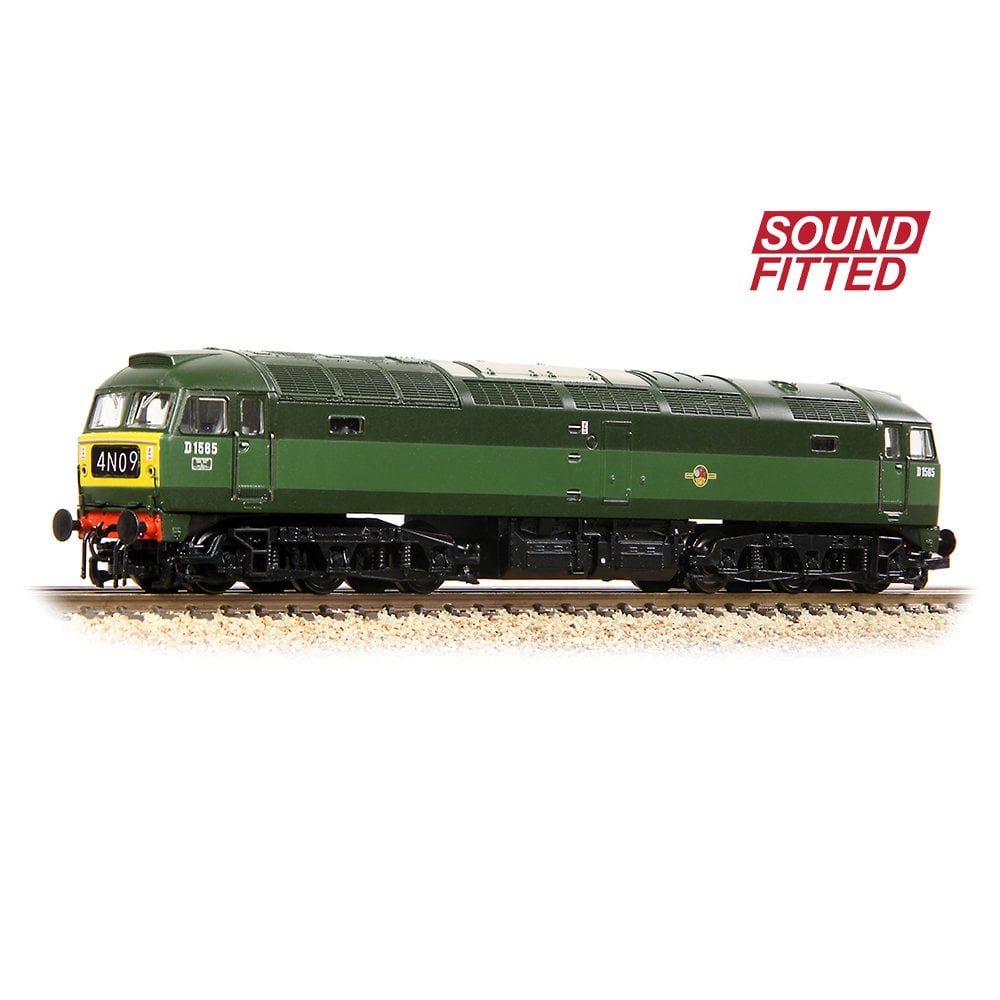
Class 47/0 D1565 BR Green (Small Yellow Panels) DCC Sound
The Class 47 was British Railways’ most prolific class of main-line diesel locomotive and so it’s no surprise that high fidelity models of these ever-popular machines are available in N Scale as part of the flagship Graham Farish range. This model tells the story of the Class’s early days of service, sporting original features and carrying the iconic two-tone green livery in which the majority of the fleet was outshopped, complete with small yellow warning panels at either end.
Features:
SOUND FITTED – Fitted with a ESU Loksound V5DCC Sound Decoder
Length 139mm (over couplings)
Coreless, twin shaft motor with two flywheels providing drive to both bogies
All axle drive
Electrical pickup from eight wheels
Diecast metal chassis block
Designed to operate on curves of second radius (263.5mm) or greater
Directional lighting, switchable on/off at either end on DCC or Analogue control
Cab lighting, switchable on/off (when used on DCC only)
Speaker installed in all models for optimum sound reproduction
Detail Specific To This Model:
Pristine BR Green (Small Yellow Panels) livery
Running No. D1565
Glazed Headcode Panels Displaying Blinds 1E11 and 4N09
Twin Arm Windscreen Wipers
High Intensity Headlight
Round Buffers
Bodyside Step below Cab Door
Full Cab Roof Vents
Original Three-Piece Radiator Grilles
Ribbed Exhaust Panels
Spanner Mk3 Roof Boiler Port
1,250 Gallon Water Tanks with Water Chutes
Open Bogie-mounted Cab Steps
- Era 5
- N Scale
CLASS 47 HISTORY
Towards the end of the 1950s, British Railways began planning a new fleet of diesel locomotives and after investigating several prototypes, BR decided to place an order with Brush Engineering for 20 locomotives during February 1961. The resulting design became the iconic Brush Type 4 Diesel locomotive, a practical, versatile design with a very distinctive cab. Powered with a Sulzer engine and initially rated at 2,750hp, the locomotive could achieve a top speed of 75mph with a tractive effort of 55,000lb. Building commenced in January 1962 and the first locomotive No. D1500 appeared in late September of the same year with test runs on the London Midland Region and Western Region. The design was a success and BR went on to order a total of 512 with continuous production through to early 1967, forming the largest single class of main-line diesel locomotives in the UK.
During this time and subsequent years, several variations appeared with an increase in speed and tractive effort to 95mph and 62,000lb respectively. Originally fitted with four character train reporting head-codes, these changed to marker lights, with the addition of high intensity lights and roof aerials in the late 1980s. Other variations involved the fitting of different types of steam heating boiler for early BR coaching stock, later replaced with electric train heating for use with modern rolling stock. The numbering system started with four figures but changed to five with the introduction of the TOPS coding system which saw the locomotives classified as Class 47 Diesels with variations such as 47/0, 47/2, 47/3, 47/4 and 47/7. By the end of the 1990s, half of the Class 47 fleet had been withdrawn or scrapped, 33 have been converted into Class 57 locomotives and several have been preserved, including the original No. D1500, now numbered 47401.
Code:
UK Delivery:
In stock items are usually despatched within 1-2 working days of ordering.
Return:
All returns must be received by us within 14 days of the date you received your order, please allow at least four days for postage. You will be required to cover the shipping and they must be returned via a traceable method – such as Royal Mail Signed For. We cannot accept responsibility for returned items until they are signed for by us.