This site uses cookies to provide and improve your shopping experience.
If you want to benefit from this improved service, please opt-in.
Cookies Page.
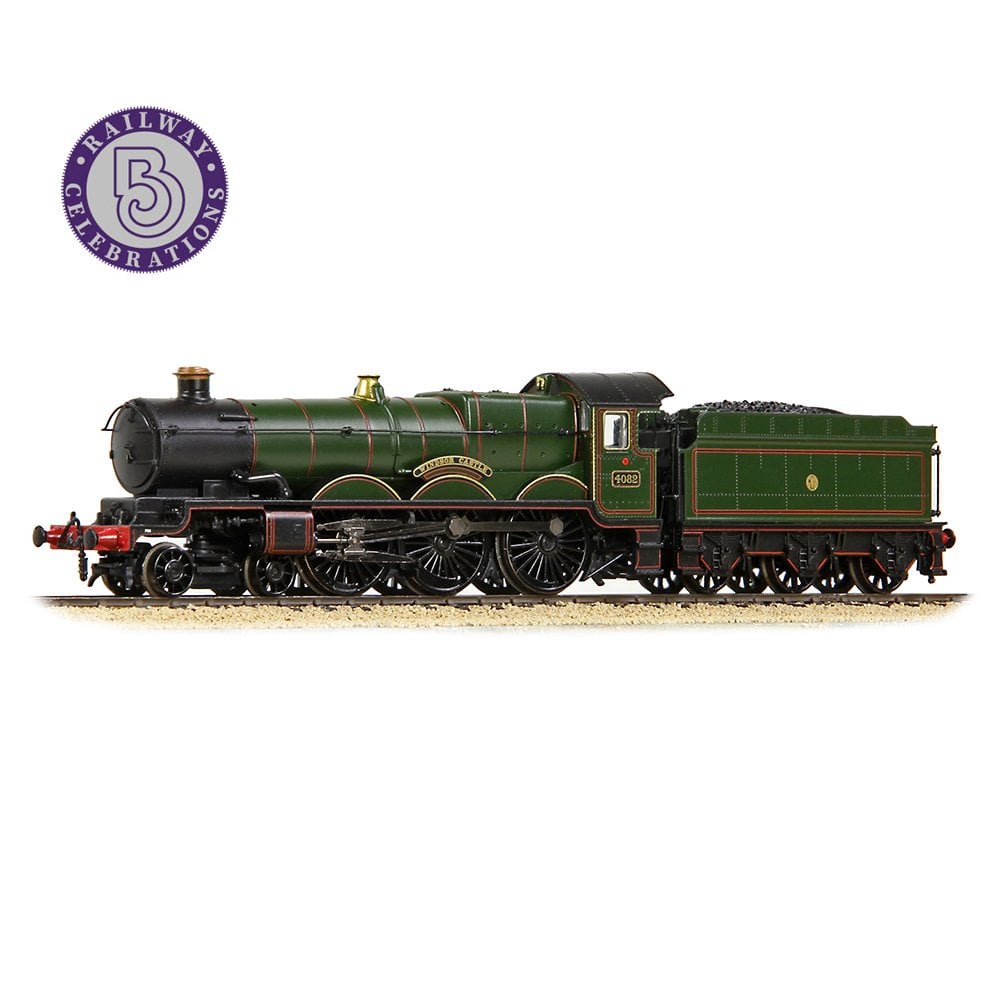
GWR 4073 'Castle' 4082 'Windsor Castle' GWR Lined Green (Shirtbutton)
The model that started a revolution as the first British N Scale steam locomotive to be made with SOUND FITTED, the Graham Farish ‘Castle’ has a technical specification as impressive as its good looks, with a powerful coreless motor driving the wheels through a diecast metal gearbox, all wheel pickup from the driving and tender wheels and separate metal bearings fitted to the driving wheel axles, smooth and reliable running is guaranteed. The tender houses a speaker and Next18 DCC decoder socket, making it easy to add sound, or opt for a SOUND FITTED version and the work is done for you, so you can enjoy realistic sound effects straight from the box on both Analogue and DCC.
Details on this model:
Pristine GWR Lined Green (Shirtbutton) Livery
Running No. 4082
Named ‘Windsor Castle’
Collett 4,000-gallon Tender
Single Chimney
Inside Cylinder Chest: Box Pattern with Curved Front
Straight Cylinder Steam Pipes
Tapered Buffers
Horizontal Cab Side Handrail
Rear Sandboxes Behind Cab Steps
Short Nameplates
Features:
Equipped with a Next18 DCC Decoder Socket – Recommend Decoder item No. 36-567A
Length 145mm (over couplings)
Coreless motor
Electrical pickup from all driving and tender wheels
Separate metal bearings fitted to each driving wheel axle
Metal bearings fitted to each tender wheel axle
Diecast metal chassis block
Diecast metal gearbox, with gearing arranged for prototypical running speeds and haulage capabilities
9mm (N gauge) wheels to NEM310 standards with authentic profile and detailing
Traction tyres fitted to the rear driving wheels for assured haulage capabilities
Valve gear of metal construction
Discreet fixed locomotive to tender drawbar with integral electrical connections
Coupling pocket to NEM355 standards fitted to the front bogie
Removable coupling pocket to NEM355 standards fitted to the tender chassis
Designed to operate on curves of second radius (263.5mm) or greater
High-precision, injection-moulded bodyshell, running plate and tender with separately fitted details parts including smokebox door, lower front lamp irons, steam pipes, whistle and reverser
Separately applied metal components including handrails, buffers and sand pipes
Dome, filler cap, water scoop and vacuum pipe added to the tender as separate parts
Tender fitted with metal coal-effect load
Detailed cab interior including boiler backhead controls and gauges, brake standard and water scoop standard
Hinged and posable metal fall plate between the locomotive and tender
Each model supplied with a full set of accessory parts including dummy screwlink couplings and front vacuum pipe
Speaker installed in the tender of all models for optimum sound reproduction
Zimo MS590N18 DCC Sound Decoder fitted to SOUND FITTED versions
- N Scale
GWR CASTLE CLASS HISTORY
The first of the GWR 4073 ‘Castle’ Class locomotives was built in 1923 to the design of then- Chief Mechanical Engineer Charles Collett. The type was intended for express passenger trains and used the 4-6-0 wheel arrangement so favoured by the GWR and built on the success of the earlier Star Class which first entered traffic in 1907 albeit with a new, larger boiler making it more powerful and capable of handling the longest expresses.
Over a period of 27 years a total of 155 Castles were built by the GWR’s Swindon Works, joined between 1925 and 1940 by 16 more that were converted from older locomotives, mostly Stars. All 171 locomotives were named, usually after Castles in the west, but those rebuilt from Stars generally retained their original names although during their careers some Castles carried other names, including those of noble Earls and some named after RAF aircraft used during World War Two.
The Castle Class turned out to be one of the GWR’s most successful designs, they were not as powerful as the later King Class locomotives, however these were restricted to a small number of routes due to their greater weight, a problem not faced by the Castles which could be found hauling many of the fastest and heaviest express workings across a large part of the GWR network.
So impressive was the original design that very few developments were made during their service lives. Streamlining was trialled on one example, but the GWR did not pursue this idea, and several were converted to oil firing for a short period but again this came to nothing. The fitting of a double chimney to 65 members of the class from 1956 was the most significant change as BR bid to improve high speed performance.
The first withdrawal came in 1950 when ‘Star’ conversion No. 4009 bowed out of service, but the type remained strong until 1965 when No. 7029 ‘Clun Castle’ was the last to be withdrawn after it had worked the final steam out of Paddington on 27th November 1965. ‘Clun Castle’ is among eight Castles that survive in preservation today, although the future of one, No. 7027 ‘Thornbury Castle’ which has never been restored from scrapyard condition, remains uncertain.
Code:
UK Delivery:
In stock items are usually despatched within 1-2 working days of ordering.
Return:
All returns must be received by us within 14 days of the date you received your order, please allow at least four days for postage. You will be required to cover the shipping and they must be returned via a traceable method – such as Royal Mail Signed For. We cannot accept responsibility for returned items until they are signed for by us.