This site uses cookies to provide and improve your shopping experience.
If you want to benefit from this improved service, please opt-in.
Cookies Page.
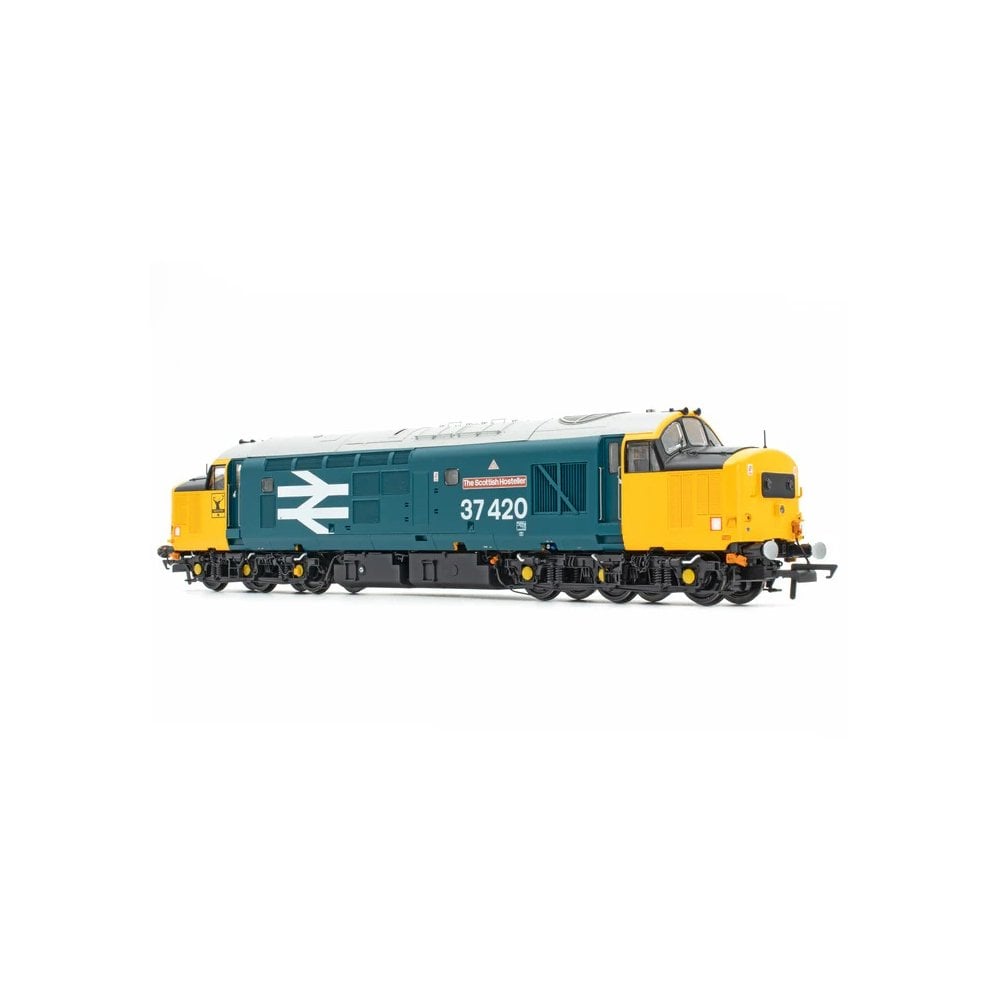
Class 37 37420 'The Scottish Hosteller' BR Large Logo
No. 37420 was the penultimate member of the Inverness ‘eight’, Nos. 37414-37421, the octet of locomotives allocated to the far north for working passenger and freight trains to Aberdeen, Kyle of Lochalsh and Wick/Thurso, that famously wore the Highland Rail ‘stag’ branding. Converted to Class 37/4 configuration in December 1985 its new specification included various cosmetic upgrades as well as electric train heat (ETH) capability rated at 30, enough to provide juice to six or seven pressure vent Mk.2s, modified CP7 bogies regeared for a top speed of 80 mph and Brush BA1005A alternators to replace the original generators.The Inverness batch was also fitted with Radio Electronic Token Block (RETB) equipment soon after ‘refurbishment’ to work the Dingwall-Kyle line and the recently commissioned section to Wick and Thurso. Like all 31 members of the sub class, the former No. 37297 (originally D6997), was released from Crewe Works in large logo livery. However, in comparison to the Eastfield and Cardiff allocations, and the RETB-fitted Class 37/0s that preceded them, this group did not universally receive names.Happily No. 37420 was one of the three that did, being dedicated The Scottish Hosteller on 28 June 1986 at the Inverness Open Day. After four and a half years working out of the Highland capital, it joined the Thornaby FCTY Trainload pool in May 1990 retaining its full Scottish regalia, albeit with a colourful Kingfisher logo on the cabside, until it became the last ‘37/4’ painted into the general user InterCity Mainline scheme the following December. Six years later it also became the last Type 3 to carry Regional Railways livery and it was switched off in July 2000. It was cut up at Hull’s of Rotherham in February 2008.
Features:
Highly detailed OO scale model, 1:76.2
Heavy die-cast metal chassis
Accurate tumbleholme, nose, cab roof and cantrail curves taken from 3D Laser scan and extensive surveys
Timeframe specific details, including but not limited to;
Bogies (Fabricated and three variations of Cast)
Fuel tanks (As built and with later smooth-sided long range fuel tank)
Early Class 37/0 features frost grille, boiler filler panel and access steps
Early Class 37/0 features illuminated split headcode displays with a selection of different four-character headcodes
Class 37/6 have operational WIPAC light clusters and top headlight and numerous different nose slides all including multiple working socket
Three styles of buffer: large round Oleo, oval and squared oval
Three styles of nose grilles: as built, refurbished ‘split’ and refurbished ‘single piece’
Boiler exhaust, and two styles of plated boiler panel
With or without bufferbeam skirts
With or without cab roof vents and bodyside windows
Nose and roof aerials and antennas (where applicable)
Three styles of windscreen: standard, centre toughened and all toughened
Three styles of cab interior: as built, refurbished and modern DRS locos
Four bufferbeam variations with different piping configurations
Door kickplates where applicable
Multiple body and nose slides to accurately represent almost every member of the class, including three variations of cantrail grille: early EE (for D6700-D6704), later EE and RSH
Four roof styles: Original double riveted, single riveted, welded and welded with antennas
Separately applied etched metal and high fidelity plastic detail parts, including grab handles, aerials, steps, wipers, nameplates, crests and more.
Etched metal door kickplates (where applicable), ‘frost’ grille (where applicable) & super fine etched metal roof grille
Scale width wire handrails
Turned brass roof-mounted horns on centre headcode examples
Full underbody tank detail with brackets and pipework
Bogies feature separate footsteps, etched footsteps, brake cylinders, speed recorder, end brake rigging and very fine brake chain
Brake blocks on trucks (bogies) in line with wheels (can be moved for EM/P4 gauges)
Numerous other locomotive-specific details yet to be revealed!
RP25-110 profile OO gauge wheels with fine scale ‘drop in’ EM (18.2mm gauge) and P4 (18.83mm gauge) wheels available separately
Accurate high-fidelity miniature snowploughs
Fully sprung metal buffers, extra-fine factory-installed pipework and screw couplings
Correct height mini-tension-lock couplers with NEM socket as well as a fully detailed bufferbeam
Every model includes PowerPack / Backup Power Capacitor Bank for up to ten seconds of power free running, flicker free lighting and continuous sound
High Performance traction, to include;
High-quality five-pole motor with two flywheels
Metal Helical Gear box for maximum performance and slow speed running
Gearing arranged so locomotive can achieve a scale top speed of 100 mph (160 km/h)
DCC ready with PowerPack Super-capacitor for uninterrupted power and super low speed running
All wheel drive and all wheel pickup
All models include our motorised roof fan with dedicated silky smooth coreless functionality on both DC and DCC.
WIPAC light clusters where appropriate with day and night-time settings
Separately switched cab lighting and illuminated, details driver’s console, auto off on movement
Switchable red tail lights
DCC Sound Versions include:
ESU LokSound V5 DCC Chip
Customised Dual-Speaker Technology with;
Large Accurathrash Bass Speaker
Smaller 'iphone' style cube for higher frequencies
DCC ready with PowerPack Super-capacitor for uninterrupted power and super low speed running
- OO Scale
Code:
UK Delivery:
In stock items are usually despatched within 1-2 working days of ordering.
Return:
All returns must be received by us within 14 days of the date you received your order, please allow at least four days for postage. You will be required to cover the shipping and they must be returned via a traceable method – such as Royal Mail Signed For. We cannot accept responsibility for returned items until they are signed for by us.