This site uses cookies to provide and improve your shopping experience.
If you want to benefit from this improved service, please opt-in.
Cookies Page.
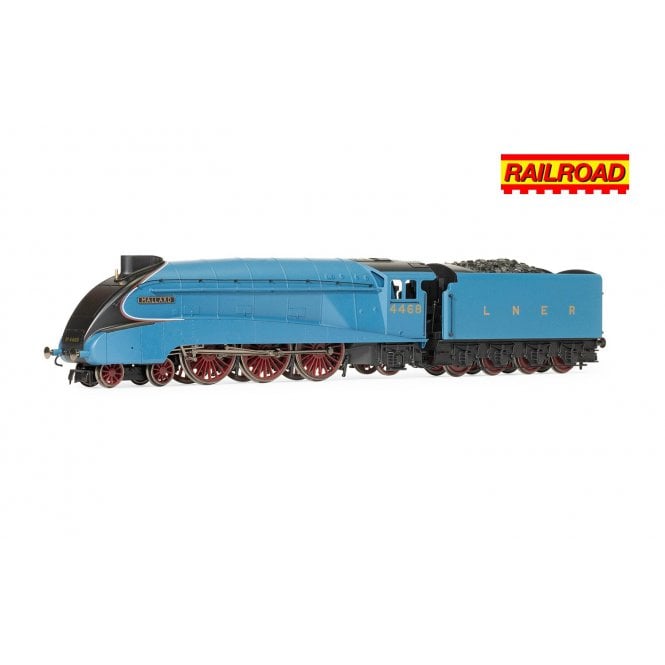
LNER A4 Class 4-6-2 4468 ‘Mallard’ in 1938 condition
Includes
- Accessory bag includes brake rigging and vacume pipes
- 3 Pole motor with brass fly wheel
- 8 PIN DCC Ready socket
(NOTE: This model is compatiable with the HM7000TXS Sound File decoders. This will require the Hornby HM7000 App or a suitable Digital Controller to operate)
- NEM Couplings and Pockets
- Will traverse 2nd raidus curves minimum (R606, R607)
- Railroad Range
- OO scale
Locomotive information:
The LNER Gresley A4 is probably the most iconic Pacific Express design of locomotive in Great Britain, with its streamlined casing. It was a classic symbol of the attitude towards speed and design in the 1930s, which saw increased competition to the railways from road and air travel. The LNER Board knew that they had to make travel between the major cities faster, comfortable and more reliable. High speed diesel services were starting to make an impact abroad and in May 1933, the German State Railways diesel-electric Fliegende Hamburger entered service, running for extended periods at 85mph.
By 1934, in the USA, Burlington Zephyr had reached 112.5mph during a longer 1,015 mile journey. Nigel Gresley, the LNER's Chief Mechanical Officer, travelled on the Fliegende Hamburger and was impressed by its streamlining, although he realized it was only efficient at high speeds. Gresley was certain that a modified A3 Pacific, with streamlining, could haul greater loads than the German or US locomotives, at the same speed or faster and a series of trials were conducted to confirm the Al's suitability.
With the trials successfully completed, the LNER Board gave Gresley the go-ahead to create the "Silver Jubilee" streamlined trains, the first of the new streamlined A4s.The streamlining of the A4s' steam circuit, higher boiler pressure and extension of the firebox to create a combustion chamber made them more efficient than the A3 as they consumed less coal and water- especially later on when they were also fitted with a Kylchap double chimney. This improved their free steaming capabilities further. Their streamlined design not only made them capable of high speeds, but created an up draught of smoke, preventing obscuring the driver's vision that was such a major problem on the Class A4 engines. The story goes that during wind tunnel testing, after several unsuccessful efforts to get the smoke to lift clear, a thumbprint was inadvertently left on the clay model just behind the chimney. This succeeded in clearing the smoke and was incorporated into the final design.
In total, 35 A4s were built in four batches: 2509 - 2512, 4462- 4469, 4482 - 4500 and 4900 - 4903, between 1935 and 1938. They spent their working lives hauling express passenger services from King's Cross to Edinburgh via York and Newcastle. Although the Deltics proved worthy successors of the A4s on East Coast Mainline express services in the late 1950s, other diesel classes were unreliable. The A4s were kept in service until the mid-1960s, the last service under British Rail being the Aberdeen-Glasgow service on September 14, 1966.It was in July 1938 that 'Mallard' was recorded travelling at 126mph at Stoke Bank on the East Coast Mainline, snatching the record from the German railway by a mere 1.5 mph - a record that still stands to this very day.
Code:
UK Delivery:
In stock items are usually despatched within 1-2 working days of ordering.
Return:
All returns must be received by us within 14 days of the date you received your order, please allow at least four days for postage. You will be required to cover the shipping and they must be returned via a traceable method – such as Royal Mail Signed For. We cannot accept responsibility for returned items until they are signed for by us.