
- Home
- Plastic Kits
- Aircraft Plastic Kits
- Airfix Messerschmitt Bf 109G-5/6 (1:24)
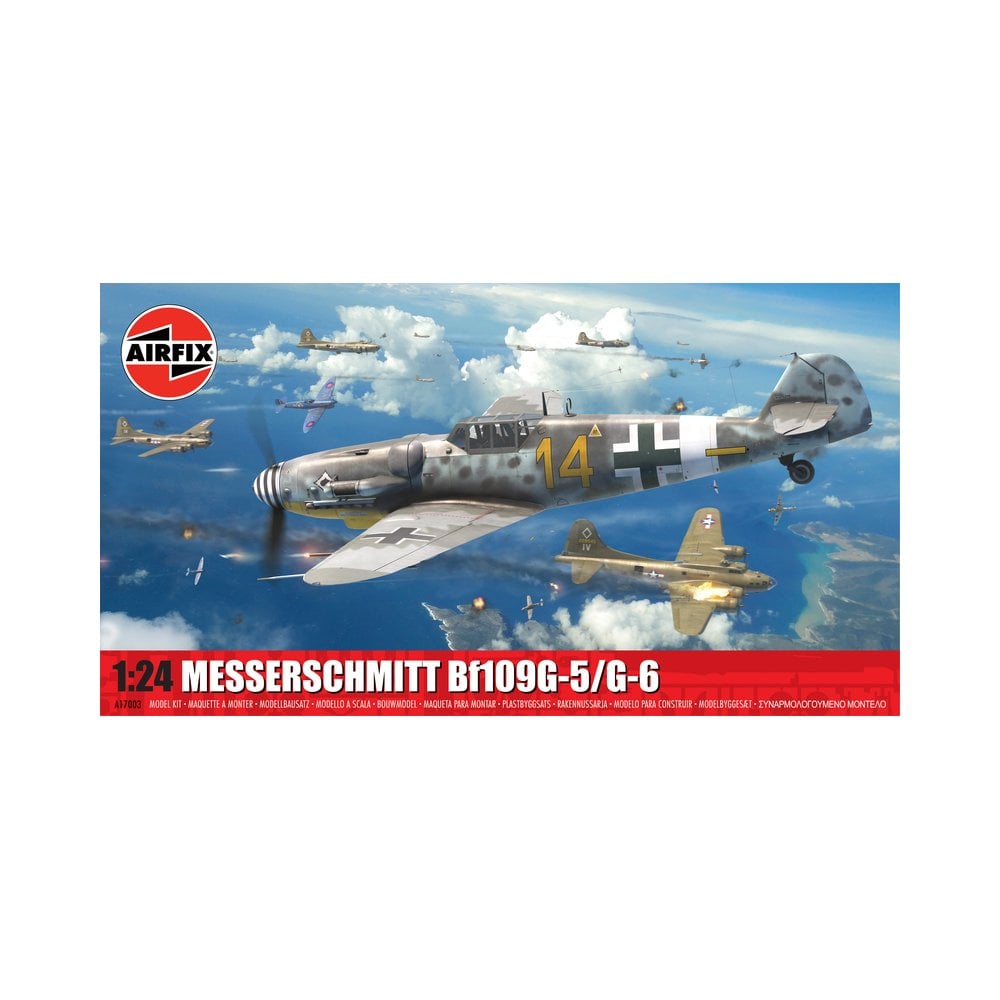
Airfix Messerschmitt Bf 109G-5/6 (1:24)
- £89.99 £74.99
- RRP £99.99 £83.33
- |
- |
- (%)

Messerschmitt Bf 109-G5/6 (1:24)
Includes:
- Option to build model with or without the fully detailed DB605 engine
- Engine cowlings and oil cooler can be posed in open or closed positions
- Choice of two types of engine cowlings (MTT and Erla)
- Canopy can be posed open or closed (two canopy types included)
- Additional engine and cockpit parts included for G-5 (pressurised cockpit version)
- Optional 300l fuel tank and wing cannon “Gondolas”
- Ailerons, elevators and rudder can be offset to add life to the model
- Radiator and wing flap position can be customised
- Many optional parts to suit specific aircraft builds, such as rudder pedals, gunsights, trim wheels, instrument panels, undercarriage wheels/tyres and windscreens
- Detailed nose armament with machine guns, gun mounts and ammunition boxes included
- Slide moulding used to allow the capture of fine detail on engine cowlings, fuselage, exhausts and gun barrels
- Includes transfers/markings for 5 different aircraft
- Kit requires glue and paint to complete NOT included
- 1:48 Scale
History:
Arguably the most important Luftwaffe fighter aircraft of the Second World War, The Bf 109 was designed by Professor Willy Messerschmitt. The prototype first flew in May 1935. After winning a design competition against entries from Arado, Heinkel and Focke-Wulf due to its higher speed and better manoeuvrability, it entered service as the Bf 109A-0 in 1937. Early versions were flown by the Condor Legion in the Spanish Civil War, and the Luftwaffe during the Invasion of Poland.
The Bf 109E appeared in late 1938 as the first major update of the design. The Junkers Jumo 210 engine used in the earlier versions was replaced by the larger, more powerful Daimler Benz DB601. The extra heat generated needed improved radiators, which were moved from the nose to the modified and reinforced wings. The Bf 109E became a symbol of the Luftwaffe in the skies over England, dogfighting the RAF’s Spitfires and Hurricanes.
During 1940, Messerschmitt engineers were working on the Bf 109F, which featured the DB601E engine and much improved aerodynamics. The wings were reduced in area, with the new rounded wingtips being seen on all subsequent Bf109 variants. The tailplane was redesigned to eliminate the supporting struts, and fuel capacity was increased to extend the range to 1,060 m (1700km). The Bf109 F entered service in October 1940.
The DB605 engine was developed to be easier to manufacture than the complex DB601E. Increasing the displacement and compression ratio raised the power output to 1455bhp. The Bf 109, when fitted with this engine, became the Bf 109G “Gustav”. The pressurised Bf 109 G-1 began production in February 1942, with the non-pressurised Bf 109G-2 following in May 1942.
In February 1943, the nose-mounted 7.92mm MG 17 guns were upgraded to the 13mm MG 131, leading to the distinctive bulged engine cowlings of the G-5 and G-6 models. The G-5 and G-6 were the most produced Bf 109 variants, with over 12,000 aircraft manufactured. The high-altitude G-5 featured a pressurised cockpit, with an engine driven compressor and sealed canopy glazing.
The Bf 109 G could be fitted with two additional MG151/20 cannon in under-wing gondolas, as well as a 300l fuel tank, rockets and bomb racks. Tropical equipment allowed the Bf 109G to serve in the dusty conditions of North Africa.
The G-6 first equipped JG 27, 51, 53 and 77 in the Mediterranean theatre, and went on to equip many Luftwaffe fighter units in Western Europe and the Eastern Front, where the highest scoring fighter ace, Erich Hartmann, achieved a claimed 352 aerial kills.
UK Delivery:
In stock items are usually despatched within 1-2 working days of ordering.
All returns must be received by us within 14 days of the date you received your order, please allow at least four days for postage. You will be required to cover the shipping and they must be returned via a traceable method – such as Royal Mail Signed For. We cannot accept responsibility for returned items until they are signed for by us.